Kelly Criterion ne Roulette
Kelly criterion ebuulira omusibi wa zzaala alina enkizo omuwendo gw'alina okusiba. Ku roulette eddamu kyangu: tosiba kintu.

Ssente za zzaala eza Kelly = enkizo / emikisa. Enkizo bw'eba wansi wa zeero, ensengekera ekuwa ekitundu ekiri wansi wa zeero, ekitegeeza nti tosiba zzaala. Wabula enkola eno ekyayamba okutegeera lwaki abazannyi abaanoonya okusosola kwa nnamuziga baasalawo obunene bwa zzaala zaabwe bwe batyo, n'ensonga lwaki abalala bonna balina okusalawo obunene okusinziira ku nteekateeka y'ensimbi zaabwe.
Enkola eno
John Kelly (1956) asked how a gambler with a known edge should size bets to maximize long-run growth of the bankrollssenteSsente z'okuzannyisaOmugatte gwa ssente ezaawulibwa ku lw'okuzannya. Okuddukanya ssente z'okuzannyisa kwe kusalawo omuwendo gw'oteeka mu kabi ku buli zzaala ne mu buli kiseera ky'okuzannya.Soma byonna →. The answer, for a bet paying b to 1 with win probabilityokubalaObusobokaObusoboka bw'ekivaamu, okuva ku 0 okutuuka ku 1 oba 0% okutuuka ku 100%. Ennamba emu: 1/37 = 2.70%.Soma byonna → p and loss probability q = 1 − p, is to stake the fraction f* = (bp − q) / b of the bankroll. Positive f* means bet that fraction; zero or negative means do not bet. Kelly worked at Bell Labs, and his paper, “A new interpretation of information rate”, set the problem in Claude Shannon’s theory of information: a gambler who gets tips over a noisy line, at fair odds, can grow the bankroll at best at the rate the line carries information. This is a growth objective under a probability model, not a promise to finish ahead after a particular number of bets. A spending limit, finite deadline or payoutssenteEnsasulaZzaala ewangudde ky'ekomyawo, ekyogerwa nga “X ku 1” okwongera ku ssente za zzaala ezizzibwayo.Soma byonna → cap changes the decision problem.

Okusiba okwa Kelly mu roulette
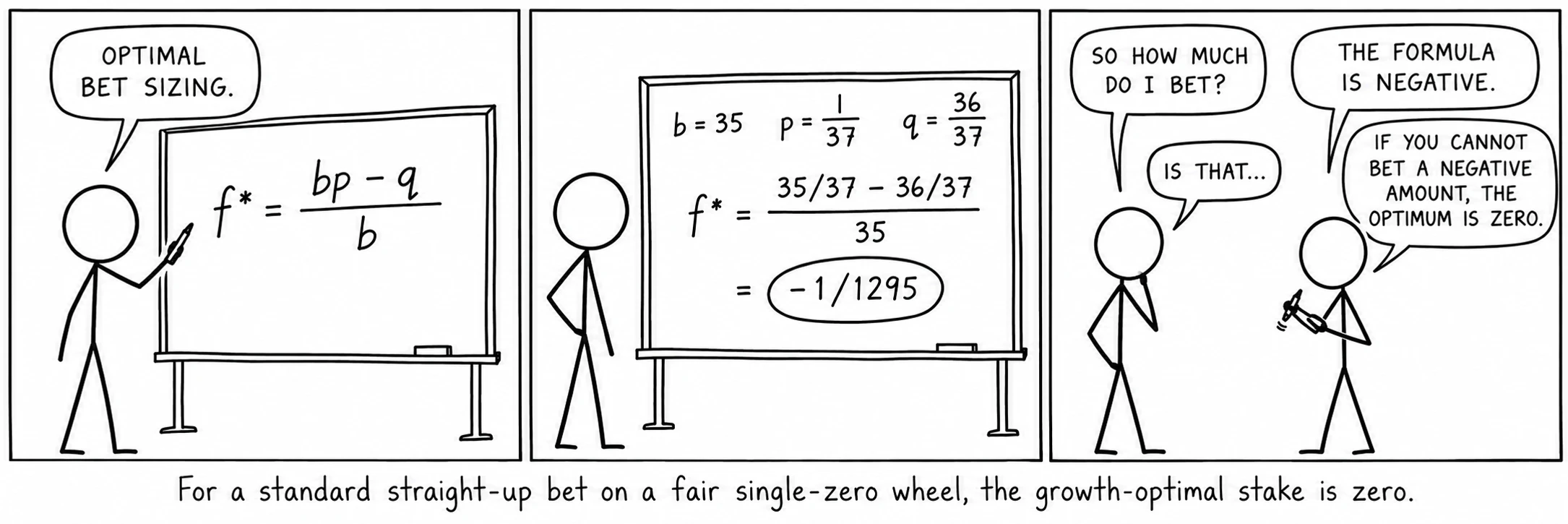
For redzzaalaEmmyufuZzaala ya emu ku emu ku nnamba 18 emmyufu. Mu Lufalansa: rouge.Soma byonna →: b = 1, p = 18/37, q = 19/37; f* = (18/37 − 19/37)/1 = −1/37. For a straight upzzaalaStraight upEnnamba emu yokka, esasula 35:1.Soma byonna →: b = 35, p = 1/37, q = 36/37; f* = (35/37 − 36/37)/35 = −1/1295. Every standard bet gives a negative Kelly fraction, because every bet has a negative edge, and the growth-optimal stake is zero. Kelly betting on roulette is a formal way of saying what the house-edge page says: no positive stake maximizes expected logarithmic growth when the bet has negative expectation. A particular session can still end in profit. La partageetteekaLa partageEtteeka ery'e Bufalansa: zeero bw'ejja, ekitundu kya ssente za zzaala ya emu ku emu kizzibwayo. Likendeeza enkizo ya kaasino ku zzaala ezo ku kitundu, okutuuka ku 1.35%.Soma byonna → needs a separate three-outcome calculation: a win, a full loss or a half-loss on zeronnamuzigaZeeroEkinnya kimu ekya kiragala ekitabikkibwa zzaala ya emu ku emu, eya dazeni oba ey'empagi; y'ensibuko y'enkizo ya kaasino. Era eyitibwa: zeero emu, 0.Soma byonna →. Its expected log growth also falls as the stake increases from zero.
Kelly we yakozesebwa ddala
Suppose a pocketebikozesebwaEkinnyaKimu ku bisenge 37 ebiriko ennamba ku rotor. Era biyitibwa: slot, cup.Soma byonna → really has a stable, known probability of 1 in 30 and pays 35 to 1. The Kelly fraction is 0.57%: about $57 from a $10,000 bankroll. Under independent spinsokubalaOkwetooloola okwetongoddeBuli kwetooloola kulina obusoboka bwe bumu k'abe ebyayita bwe biri. Gwe musingi gwa buli kubala ku mukutu guno.Soma byonna → and exact fractional staking, the geometric growth factor over 1,000 spins is about 1.7. Expected bankroll grows faster because rare large wins pull up the average. These are model calculations, not evidence that any named historical player used Kelly or achieved this result.
Ekisinga okubaawo n'eky'ekigero
The gap between the typical bankroll and the average one is wide. Take a pocket that hits 1 time in 25, a hypothetical edge of 44% per unitssenteYunitiSsente za zzaala ez'entandikwa enkola oba omuzannyi z'akozesa. Okulinnyisa zzaala kunnyonnyolwa mu yuniti kusobole okukola ku mmeeza yonna.Soma byonna → staked. Kelly stakes 1.26% of the bankroll on it. After 1,000 spins the typical bankroll has grown about 11.5 times, while the average, pulled up by a few very lucky runs, has grown about 249 times. Betting more than Kelly raises the average and lowers the typical result: at twice the Kelly stake the typical bankroll only doubles, and by two and a half times the Kelly stake it shrinks, although every bet still carries a 44% edge. In this example, half-Kelly retains about 78% of the expected log growth. This fraction depends on the probabilities and payout.
Enkizo bw'eba ya kuteebereza
Kelly uses the true probabilities, but a player usually has only estimates. Selecting the busiest pocket from a past record creates a selection problem: even a fair wheel has a busiest pocket. Its observed rate can overstate its future probability. Choosing the stake from that same record compounds the error. An independent follow-up sample helps test a proposed bias (see How to Detect Roulette Wheel Bias). Reducing the calculated fraction reduces exposure, but cannot turn a false edge into a real one.
Abantu abalina enkizo
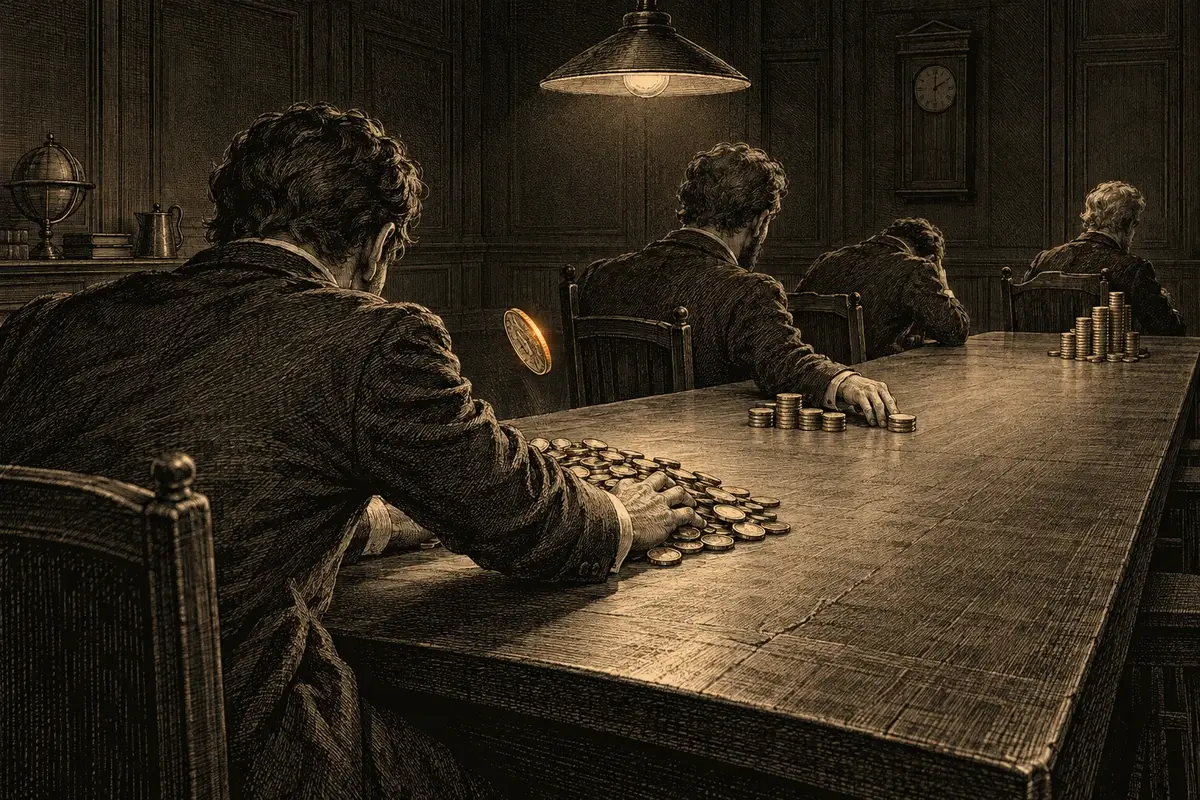
Haghani and Dewey (2016) studied 61 participants given $25 and 30 minutes to bet on a simulated coin with a disclosed 60% chance of heads. The payout cap was $250; its value was revealed when a proposed winning bet would reach it. Their reported 21% success category included balances of at least $200, while the 28% “bust” category meant less than $2, not necessarily zero. Eighteen participants bet their entire balance on one flip. The uncapped Kelly fraction is 20%, but the cap and deadline change the optimization problem. The experiment illustrates how stake choices matter even with a known advantage; it does not establish one best strategy for every objective.
Ky'oyinza okukozesa mu kifo kyayo
Awatali nkizo, okusalawo obunene kibuuzo kya nteekateeka y'ensimbi, si kya kukula: ssente za zzaala = ky'oyagala okusaasaanya ku buli kwetooloola, okusinziira ku nteekateeka y'ensimbi eya buli ssaawa n'embiro z'emmeeza (olupapula lw'okuddukanya ssente z'okuzannyisa). Kelly ky'awa omuzannyi owa bulijjo bwe butangaavu bw'eky'okuddamu kye: zeero. Buli ky'osiba okusukka zeero ye bbeeyi y'okuzannya, gy'olondawo ggwe, si eyalongoosebwa ensengekera yonna.
Ebigambo ku kitundu kya Kelly ne “okuddukanya ssente”
Betting a fixed percentage of the current bankroll is proportional staking: the stake rises after wins and falls after losses. Flat bettingenteekateekaZzaala ey'omuwendo gumuOkusiba ssente ze zimu buli kwetooloola. Kye kipimo buli kulinnyisa zzaala kwe kugeraageranyizibwako.Soma byonna → instead keeps the cash stake fixed. Neither creates an edge on ordinary roulette. With infinitely divisible stakes and a fraction below 100%, proportional staking never reaches exactly zero in finitely many losses, but the balance can become arbitrarily small. Real table minimums can prevent further play much sooner. The growth-optimal fraction remains zero.
Ensengekera
Ebibuuzo
Only when the actual probabilities, payouts and conditions give a credible positive advantage. Standard bets on an unbiased wheel have no such advantage.
Using half the calculated fraction reduces exposure to errors in the estimated edge. The familiar three-quarters-growth rule is an approximation for small advantages, not a universal identity. It does not protect against an edge that does not exist.
Nedda. Kelly alongoosa okukula ng'enkizo weeri. Okuddukanya ssente z'okuzannyisa kufuga okusaasaanya nga tewali nkizo.
Okwesanyusa n'Okubala
Gezaako bino ggwe kennyini okusooka. Buli kugonjoola kuzingiddwa; kuggulewo ng'oli mwetegefu.
Suppose a hypothetical bet on one number has a known 44% edge under standard payoutsssenteEnsasulaZzaala ewangudde ky'ekomyawo, ekyogerwa nga “X ku 1” okwongera ku ssente za zzaala ezizzibwayo.Soma byonna → and independent spinsokubalaOkwetooloola okwetongoddeBuli kwetooloola kulina obusoboka bwe bumu k'abe ebyayita bwe biri. Gwe musingi gwa buli kubala ku mukutu guno.Soma byonna →. Kelly gives a 1.26% bankrollssenteSsente z'okuzannyisaOmugatte gwa ssente ezaawulibwa ku lw'okuzannya. Okuddukanya ssente z'okuzannyisa kwe kusalawo omuwendo gw'oteeka mu kabi ku buli zzaala ne mu buli kiseera ky'okuzannya.Soma byonna → fraction. What if the same 44% edge came on one bet spread over five neighboring numbers?
Laga okugonjoola
Eky'okuddamu Awo Kelly agamba 7.1% ku ssente z'okuzannyisa, era ssente z'okuzannyisa zikula kumpi emirundi mukaaga mangu: nga emirundi obukadde 1.25 mu zzaala 1,000, so nga awalala nga emirundi 11.5.
A straight upzzaalaStraight upEnnamba emu yokka, esasula 35:1.Soma byonna → with a 44% edge wins with chance 0.04, since 36 × 0.04 = 1.44. Kelly’s stake is the edge divided by the odds: 0.44/35 = 1.26%. The typical growth per bet is 0.04 × ln(1 + 35 × 0.0126) + 0.96 × ln(1 − 0.0126) ≈ 0.00244, so 1,000 bets multiply the bankroll by about e^2.44 ≈ 11.5.
Spread one stake over five numbers and the bet wins with chance 0.20 and pays 36/5 for 1, that is 6.2 to 1: still a 44% edge, since 0.2 × 7.2 = 1.44. Kelly’s stake becomes 0.44/6.2 = 7.10%, and the growth per bet 0.01404, about 5.75 times as much. Over 1,000 bets that is e^14.04, about 1.25 million.
The edge is the same; the swings are smaller. A bet that wins one time in five has a larger growth-optimal fraction in this model, although losses can still reduce the bankroll severely. This comparison assumes the same known edge for both bets; actual predictions need independent evidence.
Assume two numbers are adjacent on the betting layoutebikozesebwaEmmeeza ya zzaalaEkipande kya zzaala ekikubiddwa ku mmeeza. Era kiyitibwa: table, felt, cloth.Soma byonna → and each has a stable, known probabilityokubalaObusobokaObusoboka bw'ekivaamu, okuva ku 0 okutuuka ku 1 oba 0% okutuuka ku 100%. Ennamba emu: 1/37 = 2.70%.Soma byonna → of 1 in 25 on independent spins. Compare a splitzzaalaSplitEnnamba bbiri eziriraanaganye, esasula 17:1.Soma byonna → between them at 17 to 1 with equal straight-up stakes on the two numbers. How much does Kelly say, and how fast does the bankroll grow compared with one such pocketebikozesebwaEkinnyaKimu ku bisenge 37 ebiriko ennamba ku rotor. Era biyitibwa: slot, cup.Soma byonna →?
Laga okugonjoola
Eky'okuddamu Tekirina njawulo: 2.59% ku ssente z'okuzannyisa ku split, oba 1.29% ku buli nnamba. Ssente z'okuzannyisa ezisinga okubaawo zikula nga emirundi 155 mu kwetooloola 1,000, so nga n'ekinnya kimu emirundi 11.5.
The split wins with probability 2/25 = 0.08 and pays 17 to 1, so it returns 18 × 0.08 = 1.44 per unitssenteYunitiSsente za zzaala ez'entandikwa enkola oba omuzannyi z'akozesa. Okulinnyisa zzaala kunnyonnyolwa mu yuniti kusobole okukola ku mmeeza yonna.Soma byonna → staked: an edge of 44%, the same as one biased pocket. Kelly’s stake is the edge divided by the odds: 0.44/17 = 2.59%.
Two straight-up bets of 1.29% each give exactly the same results. When either number comes up, one chipssenteCipuAkabonero akakiikirira omuwendo ogutakyuka, akateekebwa ku mmeeza ya zzaala okusiba zzaala. Era kayitibwa: check.Soma byonna → wins 35 to 1 and the other is lost, a net of 34 × 1.29% = 44% of the bankroll, as the split pays; when neither does, both are lost.
The growth per spin is 0.00505, against 0.00244 for one pocket, so over 1,000 spins the typical bankroll grows e^5.046 ≈ 155 times rather than e^2.44 ≈ 11.5 times. The geometric growth factor is larger because the combined bet wins more often at the same 44% edge. It is a model result, not a guaranteed bankroll.
Eky'okusesa
Ssente za zzaala eza roulette ezisinga okukuza ye nnamba buli muntu gy'amanyi dda.
Ensibuko
- Kelly, J. L. “A new interpretation of information rate.”
- Breiman, L. “Optimal gambling systems for favorable games.”
- Thorp, E. O. “Optimal gambling systems for favorable games.”
- Thorp, E. O. The Mathematics of Gambling.
- Epstein, R. A. The Theory of Gambling and Statistical Logic, 2nd ed.
- Taylor, D. G. Games, Gambling, and Probability: An Introduction to Mathematics, 2nd ed.
- Ethier, S. N. The Doctrine of Chances: Probabilistic Aspects of Gambling.
- Haghani, V. & Dewey, R. “Rational decision-making under uncertainty: observed betting patterns on a biased coin.”