Roulette n'Okusomesa Okubala
Nnamuziga wa roulette afuula obusoboka okwangu okulaba mu birowoozo. Wano waliwo engeri y'okumukozesa mu ssomo nga tozzaamu baana muzizo kusiba zzaala.
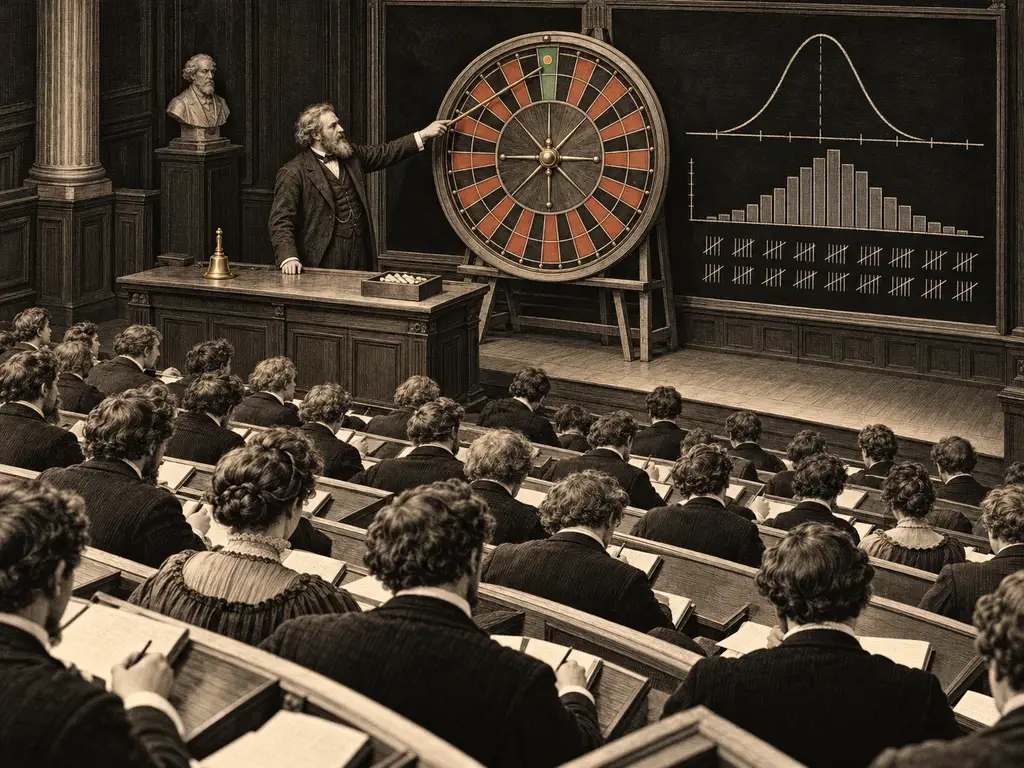
A model with 37 equally likely, independent outcomes connects counting, expectation, varianceokubalaEnjawulo y'ebivaamuEkipimo ky'engeri ebivaamu gye bisaasaanamu okwetooloola omuwendo ogusuubirwa. Kinene ku straight up, kitono ku zzaala za emu ku emu.Soma byonna →, repeated events and hypothesis testing. State the assumptions, use simulated outcomes without real stakes, and distinguish a mathematical result from a claim about how students learn.
Lwaki roulette
A fair single-zeronnamuzigaZeeroEkinnya kimu ekya kiragala ekitabikkibwa zzaala ya emu ku emu, eya dazeni oba ey'empagi; y'ensibuko y'enkizo ya kaasino. Era eyitibwa: zeero emu, 0.Soma byonna → roulette model offers 37 outcomes and a convenient payoutssenteEnsasulaZzaala ewangudde ky'ekomyawo, ekyogerwa nga “X ku 1” okwongera ku ssente za zzaala ezizzibwayo.Soma byonna → formula. It is one example among many: coins, dice and cards can also illustrate probabilityokubalaObusobokaObusoboka bw'ekivaamu, okuva ku 0 okutuuka ku 1 oba 0% okutuuka ku 100%. Ennamba emu: 1/37 = 2.70%.Soma byonna →, repeated outcomes and statistical tests. Drawing cards with replacement gives a different model from drawing without replacement.
Uniformity and independence are assumptions to examine, not properties guaranteed by a wheel’s appearance. For a standard bet covering n numbers and paying 36/n − 1 unitsssenteYunitiSsente za zzaala ez'entandikwa enkola oba omuzannyi z'akozesa. Okulinnyisa zzaala kunnyonnyolwa mu yuniti kusobole okukola ku mmeeza yonna.Soma byonna → of profit on a win, the expected net result per unit staked is −1/37. Special payouts and zero rules change that result.
Omutendera gw'amasomo
Ebyokulabirako bino biteebereza ebivaamu ebyetongodde era ebisoboka kyenkanyi ku 0–36 okuggyako nga kyogeddwa mu ngeri endala.
Okusomesa nga tosomesa kusiba zzaala
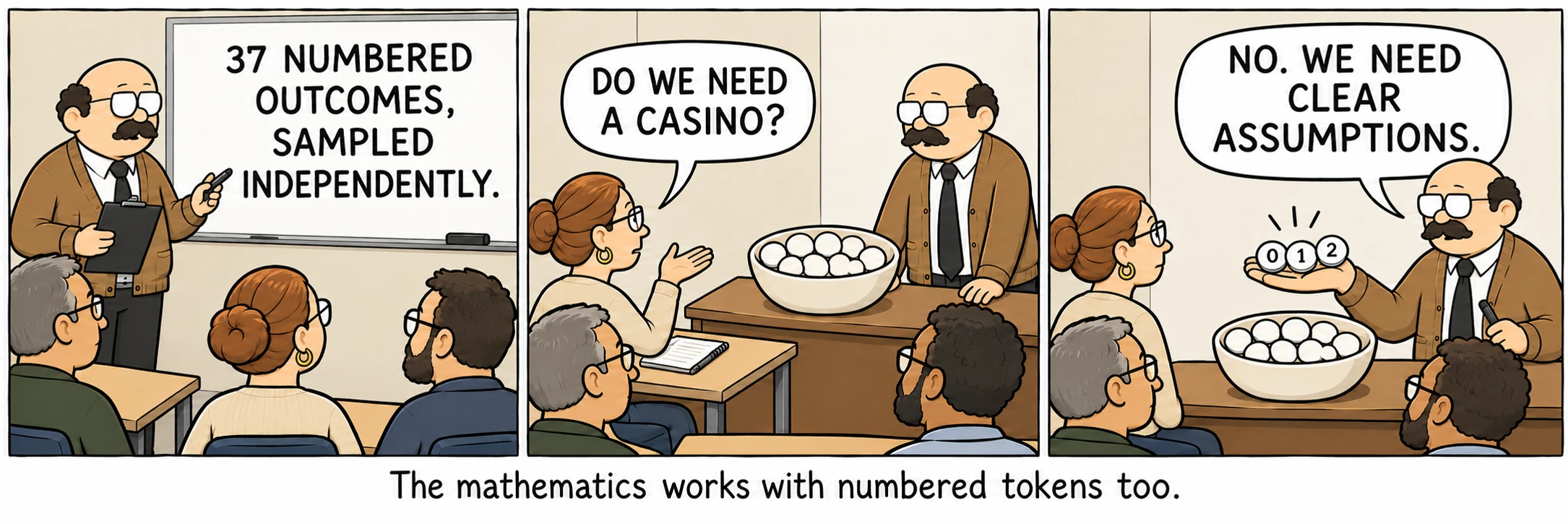
Keep real money out of the activity. A spreadsheet or a set of numbered tokens can reproduce the mathematics without a casino setting. Choose the framing for the learners and the institution; a negative-expectation explanation alone does not establish that a gambling-themed activity is suitable for every class.
Ask learners to state the sample space, payout and independence assumptions before calculating. A simulation illustrates variability; one losing session is not a proof that a system fails, and one winning session is not evidence that it works.
Ebyokukola ebikola
Compare predictions with calculations, without presenting invented guesses as classroom data. For the birthday problemokubalaEkizibu ky'amazaalibwaAbantu bameka abeetaagisa babiri ku bo okuba nga bayinza okugabana olunaku lw'amazaalibwa, oba okwetooloola kumeka ennamba nga eyinza okuddamu. Ku nnamuziga ow'ebinnya 37, okwetooloola 8 kumala okuwa obusoboka obusinga ekitundu.Soma byonna →, record the first repeat in several simulated sequences and compare the distribution with the exact model. Separate the probability of a repeat by a given draw from the expected waiting time.
For a multiple-comparisons exercise, generate many independent fair histories and record the largest pocketebikozesebwaEkinnyaKimu ku bisenge 37 ebiriko ennamba ku rotor. Era biyitibwa: slot, cup.Soma byonna → count in each. Compare those maxima with the count for one pocket selected in advance. Shuffling a history preserves all pocket counts, so it cannot test whether a high count is unusual under a uniform model.
For staking systems, record the rules, bankrollssenteSsente z'okuzannyisaOmugatte gwa ssente ezaawulibwa ku lw'okuzannya. Okuddukanya ssente z'okuzannyisa kwe kusalawo omuwendo gw'oteeka mu kabi ku buli zzaala ne mu buli kiseera ky'okuzannya.Soma byonna →, table limitemmeezaEkkomo ly'emmeezaZzaala esinga obutono n'esinga obunene ekkirizibwa. Ekkomo ery'waggulu lye liyimiriza enkola ez'okukubisaamu bbiri.Soma byonna →, stopping condition and total amount wagered. Compare many runs with the appropriate mathematical expectation; do not assume every progressionenteekateekaOkulinnyisa zzaalaEtteeka lyonna erikyusa ssente za zzaala okusinziira ku bivuddemu emabega. Okulinnyisa oluvannyuma lw'okufiirwa kuzirinnyisa ng'ofiiriddwa, okulinnyisa oluvannyuma lw'okuwangula kuzirinnyisa ng'owangudde.Soma byonna → has a fixed session win rate.
Okusoma Ebyafaayo by'Okwetooloola EbyafulumizibwaObukulu mu Kubala kw'Ebibalo
Lwaki kisigala mu mutwe
A worked example can connect an equation to observable outcomes. Whether this setting improves learning or retention would require educational evidence; anecdotes about memorable casino stories do not establish that. Ask learners to explain the assumptions and transfer the method to a neutral example, such as numbered tokens drawn with replacement.
Ebibuuzo
No. Follow the institution’s requirements and the learners’ needs. Neutral numbered outcomes can teach the same mathematics without a gambling setting.
Define the sample space and independence assumptions, calculate a simple expectation, then compare repeated simulated results. The House EdgeokubalaEnkizo ya kaasinoEkitundu kya buli ssente za zzaala kaasino ky'ekuuma ku kigero: 2.70% mu roulette ya Bulaaya.Soma byonna → and Variance pages provide worked examples.
Teguliimu ssente za ddala, akawunti wadde enkolagana ku bakola kaasino.
Eky'okusesa
Ebivaamu asatu mu musanvu, enkizo emu, ensobi z'ebyasa bibiri ez'okuyigirako.
Ensibuko
- Feller, W. An Introduction to Probability Theory and Its Applications, Vol. 1.
- Ethier, S. N. The Doctrine of Chances: Probabilistic Aspects of Gambling.