Kompyuta za Roulette
Engeri kompyuta gy'epimamu ekiseera ky'akapiira, abaasooka okuzizimba, n'obutuufu bwe zeetaaga okuba nabwo.
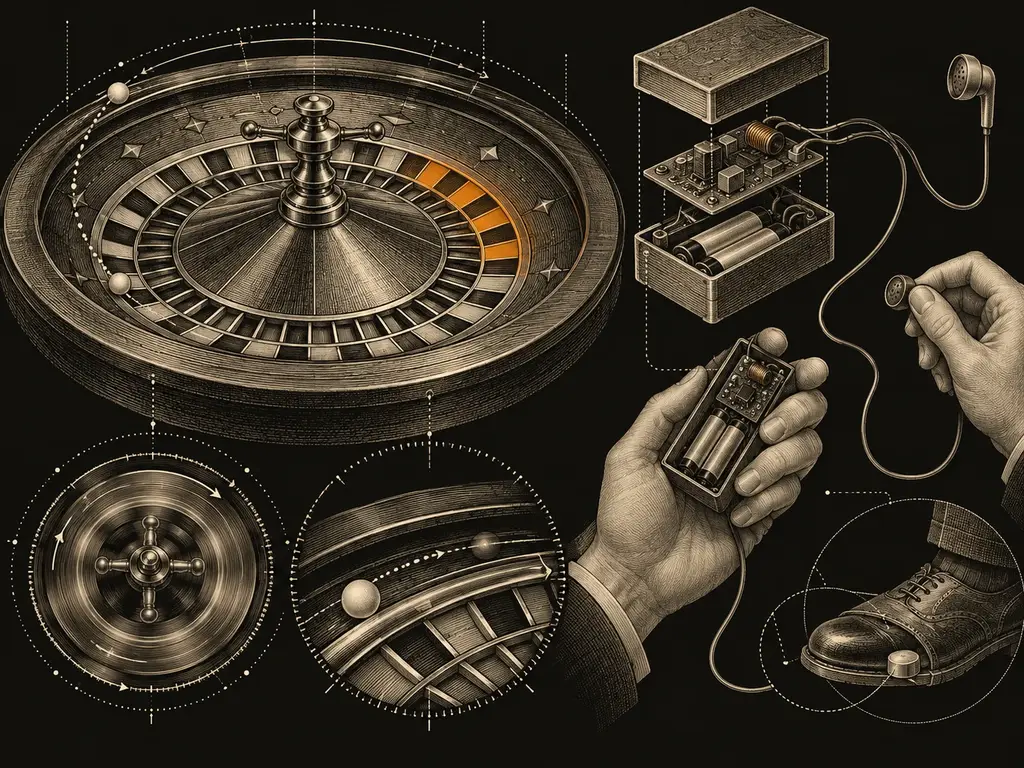
Kompyuta ya roulette epima ekiseera ky'akapiira ne rotor mu sikonda ezisooka ez'okwetooloola era n'eyogera ekitundu kya nnamuziga akapiira we kasaanidde okugwa. Edward Thorp ne Claude Shannon be baazimba esooka mu 1961, ate aba Eudaemons ne bazimba eza digito okuva mu 1976. Enkola eno yeetaaga zzaala okukkirizibwa ng'akapiira kamaze okusuulibwa: situdiyo ez'obutereevu kati ziggala zzaala ng'akapiira kasuulibwa, era Nevada ewera ebyuma ng'ebyo okuva mu 1985.
Engeri enkola ya kompyuta ya roulette esooka gye yazimbibwamu
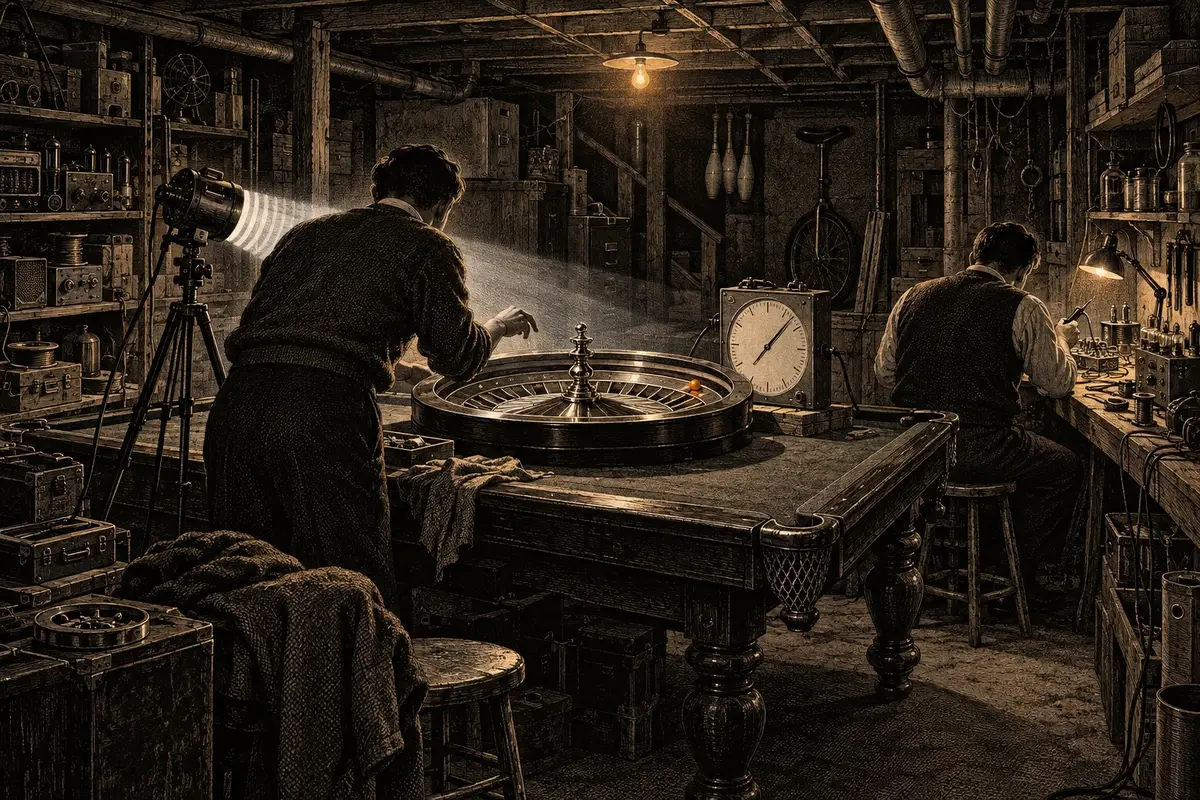
In his 1998 account, Edward Thorp dates the idea to 1955 and describes working with Claude Shannon at MIT in 1960–61. They studied a regulation wheel on a slate billiard table in Shannon’s basement, using a clock and strobe light to improve their timing.
By June 1961 they had a cigarette-pack-sized analog computer with twelve transistors. Toe-operated switches timed the ballebikozesebwaAkapiiraAkapiira akatono akakasukibwa mu lugudo nga kadduka mu ludda olukontana n'olwa rotor. Obupiira obw'omulembe bwa ivorine oba Teflon, mm 18–21.Soma byonna → and rotorebikozesebwaRotorEkitundu kya nnamuziga ekyetooloola ekirimu ebinnya.Soma byonna →; tones identified one of eight sectorsnnamuzigaEkitundu kya nnamuzigaEkitundu ky'ebinnya ebigoberegana ku nnamuziga, nga kyawukana ku kibinja ku mmeeza ya zzaala.Soma byonna → to bet on. Thorp reports testing it in Las Vegas that summer with ten-cent chipsssenteCipuAkabonero akakiikirira omuwendo ogutakyuka, akateekebwa ku mmeeza ya zzaala okusiba zzaala. Era kayitibwa: check.Soma byonna →. Repeated breaks in the earpiece wires prevented sustained serious betting. Distance and competing work later kept the project from continuing.
This is the inventor’s retrospective account, not an independent casino trial report. His 1969 paper gives 1957 for the initial idea; the later account gives 1955. Both describe work completed by 1961.
Kompyuta za digito ezaasooka
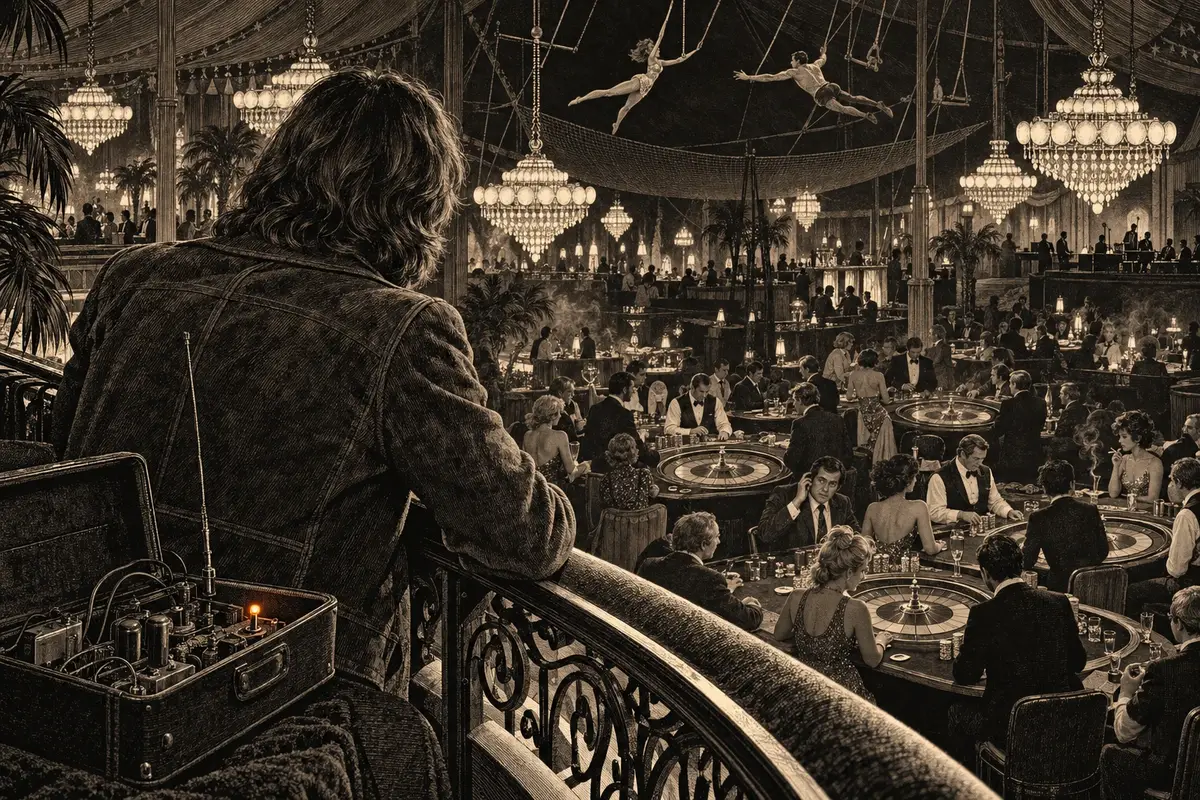
Ekyuma kya Thorp ne Shannon kyali kya analog: olukusa lwakyo olw'amasannyalaze lwe lwali pulogulaamu yaakyo, era okukyusa enkola kyategeeza okuddamu okuyunga waya. Microprocessor yaggyawo ekkomo eryo. Alan Lewis, omuyizi e Caltech, yatwala kompyuta ya digito gye yazimba yekka mu nsawo ya kkamera e Circus Circus mu Las Vegas mu 1972, n'apima ekiseera kya nnamuziga ng'ali ku kayumba aka waggulu w'emmeeza era n'aweereza okulagula ku leediyo eri munne eyali wansi. Yakola, naye teyaleeta ssente; oluvannyuma yategeera nti yali yeerabidde okukyama kwa nnamuziga. Okuva mu 1976 ekibinja ky'abayizi ba fizikisi e Santa Cruz, aba Eudaemons, baakola omulimu guno mu bujjuvu. Baagula nnamuziga ya kaasino, ne bapima akapiira, rotor, okukyama n'okubuuka, era ne bawandiika ensengekera ezirina ensengeka ttaano omuzannyi ze yatereezanga ku buli nnamuziga ng'anyiga swiiki ez'ebigere okumala eddakiika nga abiri nga tannasiba zzaala. Kompyuta yaabwe yayogeranga ekimu ku bitundu omunaana nga sikonda ntono zimaze okuyita mu kwetooloola. Ku mmeeza eya nnamaddala mu Janwaliyo 1978 yawa enkizo gye baateeka ku 25%; ebyuma, ebyasibibwanga ku mubiri ate oluvannyuma ne bizimbibwa mu ngatto, byalemanga emirundi mingi nnyo okusinga fizikisi (laba “Aba Eudaemons”).
Lwaki zzaala ez'oluvannyuma zaali nkulu
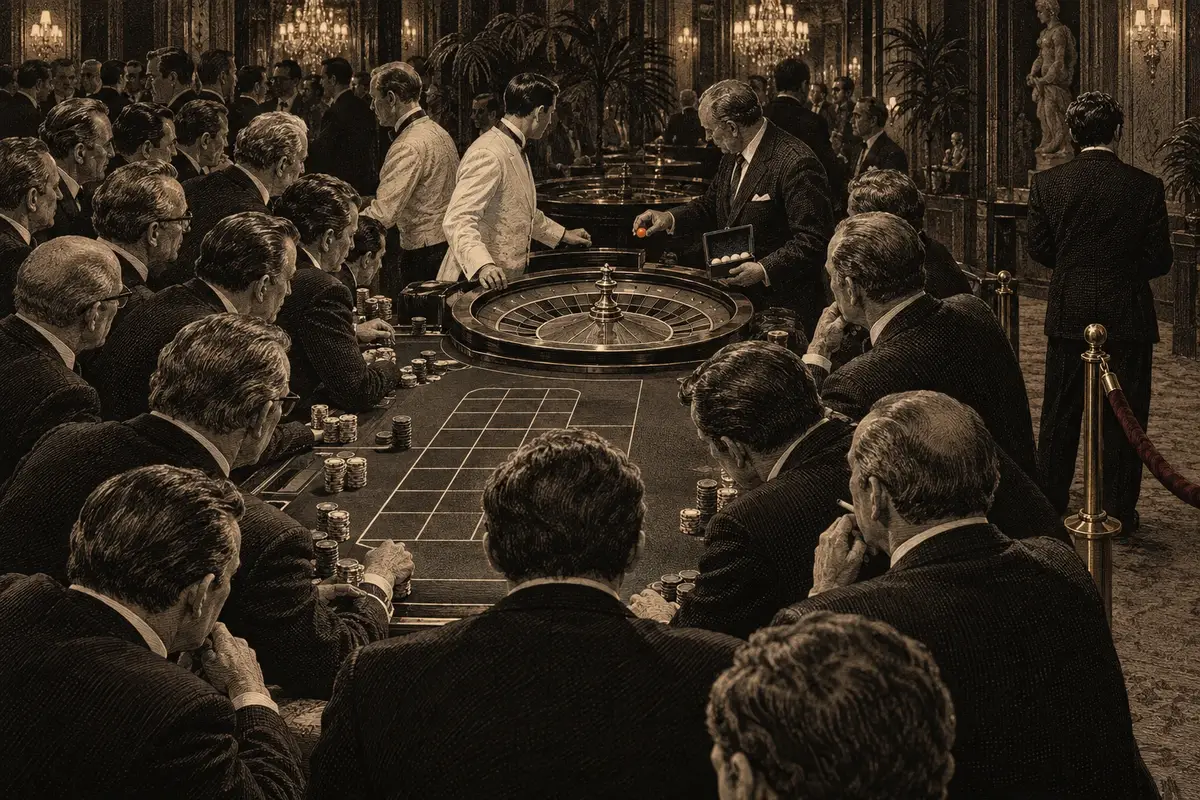
A strategy that measures the current spin cannot use those measurements if betting has already closed. Thorp’s account describes late betting in games he observed, not every modern studio. Nevada’s device provision dates to 1985; its current wording includes an approval exception.
Engeri kaasino gye zeerwanako
A predictor fitted to one setup needs fresh validation when the wheel, ball or operating conditions change. A change does not by itself prove that prediction has become impossible; what matters is the resulting prediction error and whether it still supports the proposed bet.
In his 1998 account, Thorp identifies closing bets before launch as a way to prevent his method from using the current spin. This is a constraint on that method, not evidence that every casino follows the same procedure. Check the actual betting deadline rather than assuming that a historical account describes today’s game.
Obulungi okulagula bwe kulina okuba nabwo
The table uses a mathematical model: prediction error is a centered normal distribution wrapped around 37 pocketsebikozesebwaEkinnyaKimu ku bisenge 37 ebiriko ennamba ku rotor. Era biyitibwa: slot, cup.Soma byonna →, each one unitssenteYunitiSsente za zzaala ez'entandikwa enkola oba omuzannyi z'akozesa. Okulinnyisa zzaala kunnyonnyolwa mu yuniti kusobole okukola ku mmeeza yonna.Soma byonna → wide. Expected return follows by integrating the selected pocket interval and applying 35:1 payoutsssenteEnsasulaZzaala ewangudde ky'ekomyawo, ekyogerwa nga “X ku 1” okwongera ku ssente za zzaala ezizzibwayo.Soma byonna →. This is a model illustration, not measured accuracy for a current device. At σ = 10 it gives about +43.9% for one pocket or +42.5% for five centered pockets. Break-evenokubalaOkwenkanankanaEkifo omuwendo ogusuubirwa ogwa zzaala we guba zeero ddala, ne wataba ludda lulina nkizo. Emirundi mingi ye nsasula oba obunene bwa jackpot.Soma byonna → is about 17.22 pockets for one and 17.16 for five. A different error distribution gives different values.
Ebibuuzo
Nedda. Tewali kapiira. Ennamba erondebwa pulogulaamu nga ekifaananyi ekitambula tekinnatandika.
Zandiyinzizza okuwangulwa olw'okupima ekiseera, era eyo y'ensonga lwaki tewali n'emu ekolebwa bw'etyo.
Okwesanyusa n'Okubala
Gezaako bino ggwe kennyini okusooka. Buli kugonjoola kuzingiddwa; kuggulewo ng'oli mwetegefu.
Okulangirira kw'ebinnya ebiriraanyezzaalaEbinnya ebiriraanyeEnnamba emu n'ebinnya bibiri ku buli ludda lwayo ku nnamuziga, cipu ttaano eza straight up.Soma byonna → kuteeka cipussenteCipuAkabonero akakiikirira omuwendo ogutakyuka, akateekebwa ku mmeeza ya zzaala okusiba zzaala. Era kayitibwa: check.Soma byonna → emu ku nnamba ne ku binnyaebikozesebwaEkinnyaKimu ku bisenge 37 ebiriko ennamba ku rotor. Era biyitibwa: slot, cup.Soma byonna → bibiri ku buli ludda lwayo ku nnamuziga: cipu ttaano. Okulagula kulina okugwa mu binnya ebyo ebitaano emirundi emeka okwenkanankana, era kufuna ki bwe kuba okutuufu omulundi gumu ku etaano?
Laga okugonjoola
Eky'okuddamu Kwenkanankana ku 5 ku 36, 13.9%, so ng'olw'omukisa gwokka buli 13.5%. Bwe kuba okutuufu omulundi gumu ku etaano, kuzzaayo 44% okusinga kye kusiba.
If the call hits, one chip wins 35 to 1 and comes back with its winnings, 36 chips, and the other four are lost. So a hit returns 36 for 5 staked, and the call breaks even if it hits 5 times in 36, 13.9%. By chance it hits 5 times in 37, 13.5%. That small gap, less than half a percentage point, is where the whole 2.70% comes from.
At one hit in five, 0.2 × 36 = 7.2 chips come back for every 5 staked, +44%. At one in four, +80%.
These are expected returns under the stated success probabilities and payoutsssenteEnsasulaZzaala ewangudde ky'ekomyawo, ekyogerwa nga “X ku 1” okwongera ku ssente za zzaala ezizzibwayo.Soma byonna →. A prediction would need independently measured accuracy; this calculation does not establish that any device or player achieves it.
Consider four independent, zeronnamuzigaZeeroEkinnya kimu ekya kiragala ekitabikkibwa zzaala ya emu ku emu, eya dazeni oba ey'empagi; y'ensibuko y'enkizo ya kaasino. Era eyitibwa: zeero emu, 0.Soma byonna →-mean prediction errors whose standard deviationsokubalaEkipimo ky'enjawukanaEkikolo kya kkubo bbiri eky'enjawulo y'ebivaamu; ebbanga ery'abulijjo ekivuddemu we kiba okuva ku muwendo ogusuubirwa.Soma byonna →, measured in pockets, are 1.4, 5.5, 7 and 6. The first two represent timing errors. What is the combined standard deviation, and how much would eliminating both timing errors reduce it?
Laga okugonjoola
Eky'okuddamu Nga ebinnya 10.8 byonna awamu. Awatali nsobi za kupima biseera gwandibadde 9.2, kale okupima ebiseera okubiri kwongerako 1.6 zokka.
For independent errors, variancesokubalaEnjawulo y'ebivaamuEkipimo ky'engeri ebivaamu gye bisaasaanamu okwetooloola omuwendo ogusuubirwa. Kinene ku straight up, kitono ku zzaala za emu ku emu.Soma byonna → add. The combined standard deviation is √(1.4² + 5.5² + 7² + 6²) = √117.21 ≈ 10.83 pockets.
Without the timing errors it is √(7² + 6²) = √85 ≈ 9.22 pockets. The reduction is about 1.61 pockets, not 1.4 + 5.5.
This is a hypothetical error budget. Correlated errors require covariance terms, and a standard deviation alone does not determine a prediction’s hit rate or betting return.
Eky'okusesa
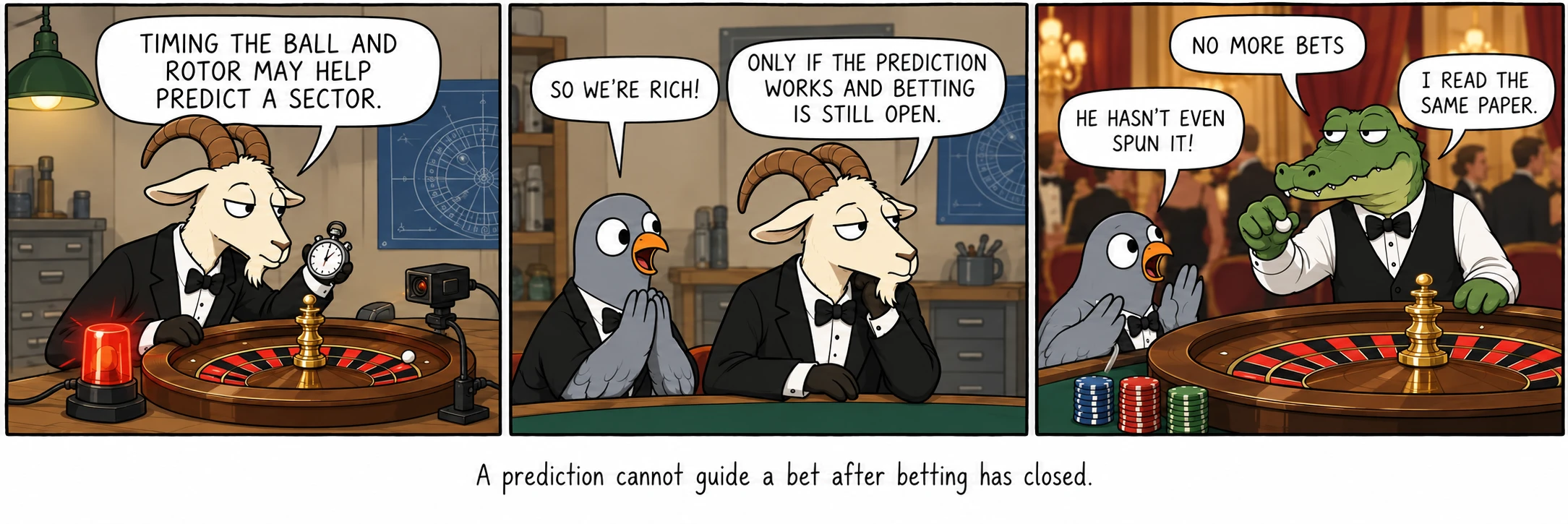
Fizikisi ekola. Ekiseera ky'okusiba zzaala kyaggalwa.
Ensibuko
- Thorp, E. O. “Optimal gambling systems for favorable games.”
- Thorp, E. O. The Mathematics of Gambling.
- Thorp, E. O. “The invention of the first wearable computer.”
- Bass, T. A. The Eudaemonic Pie.
- Small, M. & Tse, C. K. “Predicting the outcome of roulette.”
- Goldman, N. Great Gambling Scams.
- Nevada Revised Statutes, essuula 465.
- Edward O. Thorp, The Invention of the First Wearable Computer
- Nevada Revised Statutes 465.075 — kyakeberebwa nga 15 Novemba 2026
- Bradley Rhodes, A brief history of wearable computing
- J. Doyne Farmer, Roulette
- Heinz Nixdorf MuseumsForum, Shoe computer